Saturday, April 24, 2010

Ranu Raraku

I headed back to Anakena Beach this morning. One of my favorite things to do while traveling is trying to catch the various sites I visit in just the right light for photos. The sky was crystal clear this morning and I got to Anakena at about 9:00; since the beach is on the East side of the island, it was the perfect time for photos. According to Rapa Nui legend, Anakena Beach is where the Polynesian king, Hotu Matua, landed with the original settlers of the island. On a small hill overlooking the beach there stands a single moai that was re-erected by Thor Heyerdahl (the Kon Tiki guy) with the help of a few islanders. Anakena is also famous on the island for its powdery white sand and favorable surf. The beach was completely deserted when I arrived, and it was the perfect opportunity to snap a few photos of the moai on the coast. I spent an hour or so circling the moai and snapping picture after picture; enjoying the soft white sand under my bare feet and the warm, breezy, crystal clear weather.
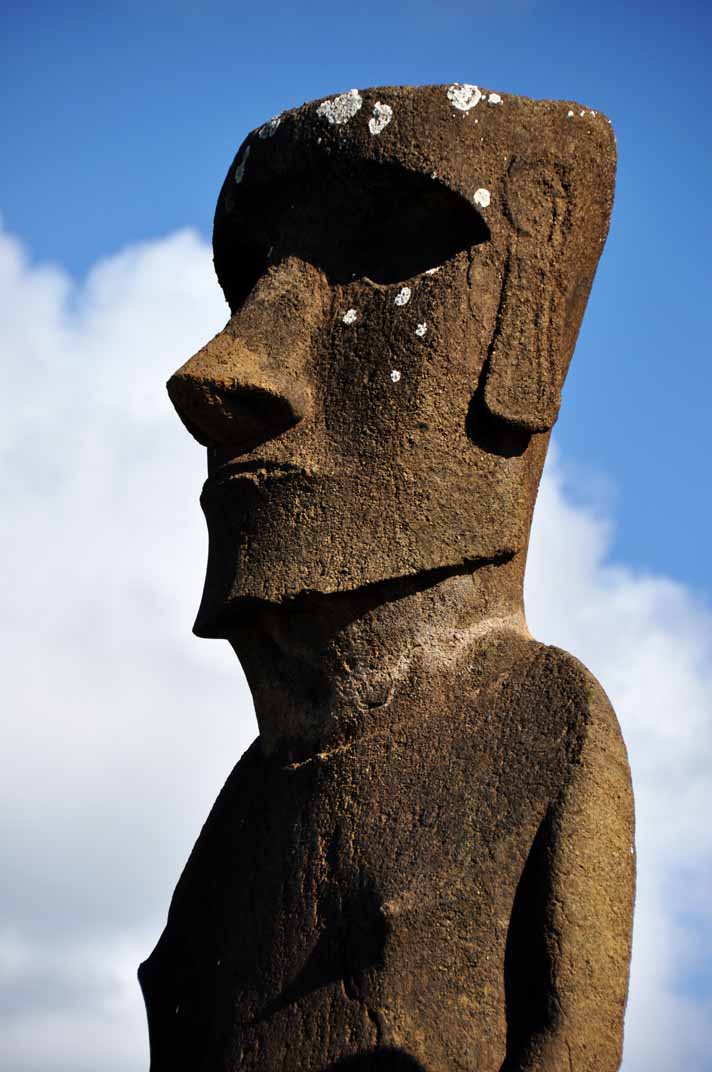
Until late this morning I had been impressed with what I had seen on Easter Island, but to be perfectly honest, it hadn’t quite lived up to my expectations. That changed pretty quickly when I visited Rano Raraku this afternoon. Rano Raraku is a small, dormant volcano on the southeast end of the island that the Rapa Nui people used as a quarry to extract lava rock to carve the moai out of. Apparently the facial features of the moai were carved before being completely extracted, then the moai would be removed and transported to other parts of the island. The result is that there are several giant moai at Ranu Raraku that are only partially carved out of the rock. The real attraction at Rano Raraku, though, is the 40+ standing moai scattered across the face of the volcano and inside the crater. I walked slowly through narrow paths leading past the moai, observing each facial expression and the tilts that each one had naturally taken on. Most moai looked pensive and stoic, although a few sported wide smiles. One moai had tipped over to an angle about 45 degrees to the ground, and the narrow pathway led directly beneath his gigantic eyes and nose. While at Ranu Raraku I happened to bump into a 50ish couple named Steve and Debbie, who are staying at my hotel, and spent the rest of my time there exploring with them. After wandering through the moai on the front side of the volcano we ventured up the slope and into the large crater on the other side. The crater is filled with plants and a gigantic lake in the middle, and on one edge of the crater sit several large moai. I enjoyed seeing a few more moai, but my favorite part of the crater was hiking to the top on the East end of it, where we had a fantastic view of Ahu Tongariki down below.

After a quick second visit to Ahu Tongariki with Steve and Debbie I stopped at the Papa Vaka Petroglyphs, a giant basalt slab in the ground covered with carvings of tuna, sharks, turtles, and canoes. Further inland I stopped at Ahu Akivi, an ahu with seven moai. Ahu Akivi is unique for several reasons. First, it is the only ahu that isn’t on the coast (or at least the only one I that I know of). Also, it is the only ahu to feature moai facing the sea. Very little is known about any of the ahu or moai on Easter Island, but one notable observation about Ahu Akivi is that the moai are oriented such that on the summer and winter solstices they are exactly facing the sunset. On my way back to the main road I stopped at Puna Pau, a quarry used by the ancient islanders to obtain red lava rock for moai topknots, called pukao. It was interesting to me to see a handful of giant topknots scattered around, but I was more impressed with the view of Hanga Roa from the top of the hill at Puna Pau. After spending the past couple of days exploring the island, it’s nice to get a view from above and see the little world I’ve been wandering around in.

Earlier today Steve and Debbie recommended that I visit a small recreation of an ancient Rapa Nui airport, so I decided to make that my last stop of the day. I knew roughly where it was from what they told me, so I cruised past Hanga Roa on my scooter and up the edge of a hill on the opposite side of the airport. I wasn’t completely sure that I was headed in the right direction, so I was a little discouraged that the road kept climbing higher and higher up the edge of the hill, with no village in sight. After driving high enough that Hanga Roa was a few thousand feet below, I finally noticed the beginning of a trailhead on the side of the road. I figured that I might not find the village I was looking for, but at least I’d have some other serendipitous adventure. I walked only fifteen or twenty feet up the trail before coming to the edge of a massive volcanic crater. The crater was at least a thousand feet across and was covered in bright green grass with hundreds of tiny ponds in the base of the crater hundreds of feet below. The opposite end of the crater had eroded away such that a giant opening revealed the wide blue expanse of ocean stretching south of the island. I recognized the sight from a few pictures I had seen around town, and realized I was at the top of the gigantic volcano Rano Kau. I hadn’t planned on visiting Rano Kau today, but the sight was incredibly scenic, and I took about a half-hour to hike along the edge of the crater and enjoy the sweeping views.

After hiking back to the trailhead I rode my scooter to the top of the road, only a quarter-mile or so away. As it turned out, I had been on the right road all along, and the village, called ‘Orongo’, was right at the top. Unfortunately the village had just closed for the day, but I happened to bump into Julia and Katarina, the two Polish girls I met yesterday, and followed them back into town for dinner. We ate at a place on the coast called ‘Au Bout du Monde’, and sat at a table that gave us a perfect view of the sun setting over the ocean as we ate. I ordered shrimp with rice, bananas, and a thick ginger sauce, and talked for an hour or so with Julia and Katarina. Naturally, when I’m traveling I tend to meet a lot of other people who love to travel, and we all shared some of our favorite travel stories. Julia and Katarina told me about their recent visit to the Galapagos islands, and I told them about visits to Angkor Wat, Bhutan, and Kruger National Park. We also shared some awkward and embarrassing travel stories; I told them about waking up at 4:30 this morning to catch the sunrise on the other end of the island (an hour too early due to me misunderstanding what time-zone I was in), only to realize halfway there that I didn’t have enough gas to make it, then turning around and going back to sleep at the hotel.

Friday, April 23, 2010

Easter Island

I reluctantly left my lavish room at the San Cristobal Tower at 6:00 this morning and headed to the Santiago Airport to catch my flight to Easter Island. Fortunately it was easy enough to doze off on the airplane, and after napping for a few hours, watching ‘The Blind Side’, and blasting a few tunes on my iPod, I had arrived at Easter Island.

Before planning my trip out here I really had no idea how far away Easter Island is from the mainland. A flight from takes just over five hours; about the amount of time to fly from Los Angeles to Honolulu. Easter Island is halfway between Chile and Tahiti, and attracts many travelers making round-the-world trips, as makes a fantastic stop mid-way through the Pacific.

I love the feeling right when I get off the plane on a tropical island. I guess I haven’t felt it too many times before… I can remember feeling it in Ko Samui, Thaiand and in Honolulu about fifteen years ago. There’s just something about leaving the plane and feeling the warm, humid, tropical air for the first time. As I walked down the tarmac towards the terminal I was excited to experience the beaches, diving, and warm climate of the South Pacific, and I smiled as I reminded myself of the reason I came all the way out here… to see the gigantic stone heads; also known as ‘moai’.

After checking into the modest ‘Residencial Martin y Anita’, I rented a motorized scooter and hurried out of Hanga Roa, the island’s only town, to spend the rest of the day exploring. I loved riding that scooter today. Even though I felt like Lloyd Christmas from ‘Dumb and Dumber’, it was just such a blast to ride along the deserted coast of the island, enjoying the scenery and scanning the landscape for my first moai sightings. I’m surprised by how beautiful the scenery of Easter Island is. I guess I never really thought about it before, but the island is beautiful. It reminds me a little of the English countryside; mile after mile of rolling green hills passed by on my left, and to my right cliffs of black lava rock plunged into the deep blue ocean. Easter Island is also filled with horses that roam freely. I don’t know whether the horses are wild or not, but every few miles I’d pass a herd of brown horses feeding on the grass or galloping along the coast. The scenery was just idyllic; between the rolling green hills, perfectly blue ocean, exotic lava rock cliffs, and herds of roaming horses, I felt like I could have been in a dream… and the dream was only made sweeter by discovering groups of ancient moai scattered along the coast.

Just a few miles outside Hanga Roa I stopped at a site called ‘Ahu Akahanga’; a site where six giant moai lie toppled on their faces. Very little is known about the moai or the ahu (giant platforms used to support the moai), but for some reason nearly all moai face inland. At Ahu Akhanga two different platforms about a quarter-mile apart feature a few toppled moai, with another toppled moai between the two at the edge of a small bay. I met a couple Polish girls who happened to be at Ahu Akahanga at the same time as me, and we took turns taking photos for each other in front of the ahu. I can only imagine what that place must have been like hundreds of years ago when the moai were still standing.

Further down the road I stopped at a site called Ahu Tongariki; easily my favorite part of the day. Ahu Tongariki features a gigantic ahu in immaculate condition with fifteen moai standing on top of it. Each moai is slightly different; some shorter than others, and with different sized noses or other facial features. My favorite of the fifteen was one that had a gigantic topknot on his head made of red lava rock. According to my Lonely Planet book, moai with topknots were fairly rare, and it’s believed that the knot represents a hair style that was popular among the original inhabitants of the island. The topknots weigh about as much as two elephants, but somehow the islanders were able to raise them onto the heads of the moai. Apparently most of the moai at Ahu Tongariki had topknots at one time, but in 1960 a tsunami hit the ahu, scattering the moai and their topknots. In 1992 a Japanese company re-erected the moai at Ahu Tongariki to restore the site to what it once was; although they only put a topknot on one of the moai.

A few more minutes on my scooter took me to Anakena Beach, a beach famous on Easter Island for it’s powdery white sand and for a small ahu with about five standing moai on it. I was lucky for most of the day and got perfectly warm, sunny weather, but unfortunately my luck turned at Anakena Beach and a relentless storm started pouring rain. I was so excited to actually be at Anakena Beach that I circled the moai a few times in the rain and walked the length of the beach. When I was sufficiently soaked I found a small shelter from the rain: the overhang of a tin shed used by national park employees. Waiting under the tin roof was easy, as it gave me a chance to look through all my favorite pictures from the day, but after about a half-hour I decided I needed to figure out what I was going to do to escape the storm for good. With seriously limited options, I decided to drive twenty minutes back to Hanga Roa in the pouring rain. Although the weather wasn’t ideal, I enjoyed taking a different route through the countryside and seeing as much of the island as possible.

After a hot shower and about another hour looking through my photos, I headed to a tiny cafĂ© called ‘Ariki o Te Pana’ for a bite to eat. My Lonely Planet book recommended the empanadas, and I wasn’t let down. I ordered a seafood empanada and got a crispy, flaky pastry filled with fresh seafood and a spicy Chilean sauce. Altogether the day has been a success, even despite the rainstorm. I’ve seen some of the best moai of Easter Island, got some incredible pictures, and still have a whole lot more to explore. I’m excited to spend the next four days here hiking, exploring, and scuba diving. Everything about Easter Island is so unique and I’m excited to discover it all for myself.

Wednesday, August 26, 2009

MacDonnell Ranges

Today was my last full day in the Outback, and I decided I had to see some more natural scenery to get a real feel for the place. The MacDonnell Ranges is a small mountain range running west to east through Alice Springs. I booked a one-day tour to explore the West MacDonnell Ranges, and although it turned out to be a series of small rocky hills by Utah standards, it still was a great way to get to know a different part of the Outback.

After a brief stop at Anzac Hill, which overlooks Alice Springs, and John Flynn’s grave, which features a giant granite boulder to honor the RFDS founder, I headed 30 miles west of Alice Springs with the rest of the group. I don’t usually like to join group tours when I travel as it’s usually much more interesting to wander around on my own, but occasionally it’s a lot more cost-effective and simpler to join a tour. Today’s tour was very different from anything I’ve booked while traveling on my own: it turned out to be a group consisting mostly of 60+ year-old Australian retirees. I guess there’s nothing wrong with traveling with retirees, and it turned out to be an interesting way to get to know some local Australians, but suffice it to say that my pace today was somewhat more relaxed.

The group made two other stops in the MacDonnell Ranges before lunchtime: one at ‘Simpson’s Gap’, and another at ‘Standley Chasm’. Both places featured dry, grassy terrain and small red-rock cliffs, and similar sites could easily be found near Cedar City or St. George. Hiking around in the tiny canyons reminded me of family trips I took as a little kid, and the eucalyptus trees and possibility of seeing a wombat added an exotic element to it all.

Spending time with groups of Australians has been a good opportunity to get a feel for the culture. Nearly every time I’ve been in a group of native Australians during the past week I’ve noticed that they make a lot of wise cracks with each other and are very witty, yet also very relaxed, friendly, and laid-back. A short conversation today between the van driver, Danny, and a random old man on the tour exemplifies the culture well:

Danny: “On your left you’ll see a river basin where aborigines traditionally performed rain dances. If you like you can all perform a rain dance of your own later on.”

Old Man (with great anticipation): “Does the rain dance involve nudity?”

Danny: “Yeah, we can do that. I’m easy goin’.”

Later today I visited the Alice Springs Desert Park, an immaculately maintained desert zoo that features authentic recreations of the various types of desert ecosystems. While walking through the River Basin ecosystem, Desert Sands ecosystem, and Woodlands ecosystem I stopped at various enclosures featuring birds and reptiles native to Central Australia. The most memorable of the animals was the ‘Princess Parrot’, an Australian parrot featuring brightly colored pink, green, blue, and yellow feathers. I also confess that I enjoyed the kangaroo enclosure; an enclosure that visitors can walk into to view the kangaroos inside, most of whom are sprawled lazily in the shade. Before leaving the Desert Park I watched the ‘Birds of Prey’ show, a presentation that featured live birds swooping through the air and performing stunts for the audience. One bird, the ‘Black Kite’ demonstrated its ability to catch prey in mid-air and eat it in flight.

At night I headed back to the ‘Sounds of Starlight Theater’ for a two-hour didgeridoo performance. Andrew Langford, the internationally acclaimed didgeridoo player I met yesterday, belted out original music using various types of didgeridoos as two other musicians accompanied him with drums, chimes, and rattles. I never imagined that a man could be as passionate about the didgeridoo as Mr. Langford is. Each of his original songs was created with a story of the Outback in mind, and Langford excitedly shared his inspiration with the crowd.

Monday, August 24, 2009

Alice Springs

Alice Springs reminds me of St. George, Utah. After a short flight from Ayers Rock this morning, I took a walk through town and noticed quite a few similarities. Both cities are mid-sized, low rise metropolises, both are surrounded by rocky plateaus, both are in the middle of the desert, both have warm, dry weather, both have streets using the grid system, both are near wildly exotic natural red-rock formations, and both are centers of tourism for the region. With that said, I doubt there are any outlet malls in Alice Springs… and I’ve never seen a wild kangaroo or an aborigine in St. George.

I began my day in Alice Springs by visiting the ‘Royal Flying Doctor Service of Australia Museum’. The museum documents the development of a flying doctor service in the outback; a service that makes it possible for Australians to live in remote areas of the outback and still receive emergency medical attention when it is needed. I was interested to learn about John Flynn, the founder of the Royal Flying Doctor Service (RFDS), and how he began the organization in 1939 with a small network of radio transmitters and a single tiny airplane. Currently the service has 19 centers of operations and extends throughout most of Australia, enabling doctors to pilot airplanes to tiny airstrips in the most isolated locations of the outback. As a side note, I also learned the meaning of the name of Australia’s national airline QANTAS; it’s an acronym: Queensland and Northern Territory Arial Service. The museum in Alice Springs is located at the current operational headquarters of the RFDS, and during a half-hour spent there I watched an employee coordinate one of the emergency flights and was even passed in the hall by an actual flying doctor.

I think I spoke too soon when I wrote in my last entry that the ‘Real Australia’ isn’t about aborigines and didgeridoos. Alice Springs is packed with aborigines. Granted, they aren’t covered in face paint and holding wild dance ceremonies like the aborigines in ‘Crocodile Dundee’, but at least 50% of the non-tourist population in Alice Springs must be aborigine. I guess it’s about like seeing a Native American in Taos, New Mexico; they’re around, but for the most part they dress and act just like everyone else.

That brings me to didgeridoos… I noticed a flyer advertising a free didgeridoo lesson in Alice Springs and headed to ‘Sounds of Starlight Theatre’ this afternoon to learn how to play with a group of about fifteen others. The lesson was conducted by Andrew Langford, a tall, blonde Australian who has lived in Alice Springs for the last 25 years and is internationally renowned for his proficiency with the didgeridoo. I was blown away with the sounds Mr. Langford was able to make with a hollow stick of wood; the rhythms, textures, and melodies he created could rival those of an accomplished violinist. I can’t say that I was quite as proficient. My rhythms and textures sounded more like an old, tired, inexperienced tuba player. Still, it was fun to try to learn the ancient aboriginal instrument, and now I have an appreciation for what it takes to really play the thing.

Later in the afternoon I stopped into the Alice Springs Reptile Center; an exhibit featuring several live reptiles from Central Australia, including a 12-foot crocodile. I happened to arrive just in time for a presentation during which visitors can handle the reptiles. An expert reptile handler showed off a few choice animals for the crowd; a lizard with skin like a pinecone and a tail that looks like a second head, a lizard with a penchant for climbing on top of peoples’ heads, and a six foot snake with skin that reflected bright green and blue colors with the light (I was reminded of a similar place I visited in Bangkok – a snake farm where the Thai staff excitedly introduced a giant King Cobra and other infamous snakes). I enjoyed handling all the reptiles at the Alice Springs Reptile Center, but my favorite was easily the long green snake, which slithered along my arms and wrapped its body around my torso.

Passing aborigines in town and playing the didgeridoo are both exciting experiences that scream ‘stereotypical Australia’ to me; but I also had the chance to go looking for wild kangaroos today. Wayne, the manager of the hostel I’m staying at, directed me to the top of a rocky hill east of Alice Springs, where he was certain I would find kangaroos. Immediately after hiking to the top of the hill I got very lucky and spotted a kangaroo hopping along. I followed the animal for a few minutes and snapped a few pictures, but unfortunately the beast quickly hopped off and I spent the rest of my time on the hill spotting no kangaroos, but heaps of their dung. Still, it was incredible to me to actually find a wild kangaroo on my own in Australia.

I finished off my day with a juicy hamburger at ‘Bojangles Saloon & Restaurant’. The place reminded me of an Old West style saloon, complete with swinging doors to enter and exit. Speaking of the Old West, I’ve decided that there are a lot of parallels between the American Old West and the Australian Outback. Stories of the Old West are filled with all the classic stereotypes; wild Indians with bows and arrows, headdresses, and facepaint, heroic cowboys and gunslingers, and the occasional mountain man and ‘I wrestled a grizzly bear’ story. These days the American Old West is a tall tale; gone but not forgotten, and with plenty of mementos to remember it by. The Australian Outback is similar. Crocodile Dundee is a heroic characterization of the Outback that incorporates all the stereotypes. Mick Dundee wrestled crocs instead of grizzlies, and while his story is legendary to anyone who has seen the Hollywood movie, it’s about as realistic as exaggerated accounts of Jim Bridger or Davy Crockett. Still, I’d love to see the movie again when I get home, and as long as I’m in Australia I’ll enjoy experiencing the modern-day, realistic version of Hollywood’s tall tale.

Uluru

While returning from the Great Barrier Reef on Friday I joked with an Australian traveler about the stereotypes Americans have of Australia…

“Every American who comes to Australia wants the ‘Crocodile Dundee’ experience; sitting around a campfire with a bunch of aborigines playing the didgeridoo.”

It would be great to spend two weeks in Australia hacking my way through the bush with a machete like Mick Dundee did in the outback; having wild late-night rendezvous with the aborigines, covering myself in face paint, and playing the didgeridoo. The real Australia is a bit different… but it can be just as colorful depending on what you make of it.

For me, part of experiencing the ‘Real Australia’ was getting to the Outback. I’ve learned that the term ‘Outback’ is very loosely defined in Australia, and doesn’t necessarily mean the raw, red wilderness; filled with kangaroos, crocs, and other wild Australian beasts. The term ‘Outback’ generally refers to everything outside of Australia’s big cities. Nearly the entire continent is the ‘Outback’, so to speak. In my mind, the premiere Outback experience has always been to see Uluru. Uluru (called ‘Ayers Rock’ by the first Europeans to discover it) is a gigantic red, sandstone monolith; an unmistakable icon of Australia that towers 1000 feet over the Outback and holds profound spiritual significance for the local aboriginal tribe, the Anangu. I budgeted two days to experience Uluru, and I packed as much as possible into the limited time that I had.

I awoke on my morning flight from Cairns just in time for the descent to Ayers Rock. My first sighting of the massive rock was a glimpse out the airplane windows from across the aisle. I quickly relocated so I could get a better view and as we descended I marveled that I was finally seeing Australia’s great natural wonder.

I began my Uluru experience by completing the ‘Base Walk’, a six-mile walk around the perimeter of the rock that introduces visitors to the soaring sandstone surface, as well as aboriginal rock art and sites of spiritual significance. To be perfectly honest, the various caves and indentations in the rock that hold significance to the Anangu don’t mean much to me, but the rock art was fascinating. A few trails branching off from the Base Walk led into small enclaves in which aborigines have left their stories on the rock over the years. Vibrant red, yellow, white, and black pigments covered the insides of the enclaves, and the many ancient paintings that were created on top of each other illustrated generations of life experiences of the local aborigines. It’s impossible to decipher the meaning of all the paintings, although the meaning of certain symbols is still understood; such as concentric circles depicting a waterhole, or the unmistakable icon for a feather or leaf. I hung around at each of the rock art locations until I felt I had fully appreciated what had been left by the ancient inhabitants, and finished my walk around Uluru with a small understanding of the Anangu culture.

My second day at Uluru was packed with outdoor activities. I began the day by riding 15 miles in a van from the Ayers Rock Resort to a sunrise viewing point. The sunrise was nice, but sunsets at Uluru are much better… and I have to interject here and say that a ridiculous number of people pay way too much money to experience an Uluru sunrise. For the cost of all my transportation in the area for two days (amounting to about 200 miles of driving altogether), hundreds of tourists choose instead to ride a giant tour bus to Uluru for just one sunrise… although with their “tour” a small, cold breakfast is included, as well as a metal camping stool to sit on.

Nearby Uluru is another rocky natural wonder: Kata Tjuta. Kata Tjuta is a series of giant rocks, and although none are as big as Uluru, the cluster of them are impressive enough to justify a visit. A 50 mile van ride took me out to the site, and I spent an hour hiking through a red, rocky gorge that was so similar to Southern Utah that I felt I could have been in Zions National Park. I talked with a young family from Wisconsin as I hiked, and learned that they are currently living in Perth while working as the American consul. The family has also lived in Bulgaria and Madagascar doing the same type of work. I couldn’t resist asking about the recent military takeover in the country in which a 30-year-old radio DJ was instated as president. The family told me they were there during the unrest, and that their daughter, Claire, was in the same elementary school class as the president’s young son.

Later in the day I headed to the airport for a helicopter ride over Uluru. Riding in a helicopter is always a bit expensive, but some of my favorite experiences while traveling have been unique ways of seeing famous sites from above (including an incredible helicopter ride over Victoria Falls last year). As the chopper lifted above the airport Uluru instantly came into view, and I loved getting higher and higher in the aircraft and seeing the rock spread out below me. To me the aerial view of the rock is entirely different than seeing it straight on from the ground. It’s obvious from the air that erosion from rainfall has created hundreds of tiny canyons in the rock where the water rushes down to the ground. I can only imagine how spectacular Uluru must be during a giant rainstorm. I would love to see towering waterfalls pour off the edge of the red sandstone. I may never actually see that; but even seeing the erosion from the waterfalls from the air was pretty amazing.

I spent the remainder of my afternoon at the Anangu Cultural Center near Uluru. The cultural center featured various artwork by Anangu people, as well as a description of ‘Tjukurpa’, the Anangu beliefs relating to the creation of the world, as well as a code of ethics and morals to guide everyday life. Tjukurpa stories are centered around legendary animals, such as ‘Kuniya’, the woma python, and ‘Liru’, the poisonous snake. The stories about the animals, or ‘Ancestral Beings’, explain the creation of all things in nature including specific physical characteristics of Uluru. Also, the Ancestral Beings are the primary figures in fables that teach basic morals values to the Anangu. The cultural center features several videos of Anangu ceremonies, and large exhibits describing how the people hunt for food and generally sustain life (I was surprised how much attention was given to describing the method by which Anangu women dig deep pits in the ground to search for honey ants). In an outdoor section of the museum an older Anangu couple demonstrated how to make aboriginal craftwork. Altogether the museum was interesting and a good use of time, but one hour spent there would have been more than enough. Unfortunately I was obligated to spend more than two hours at the museum because of the pick-up times by the bus, but it was still enjoyable, and a good opportunity to try to understand the Anangu culture.

Visiting Uluru has made me much more conscious of the tension between aboriginal people and European settlers. The relationship between aborigines and Australians is strikingly similar to the relationship between Native Americans and European settlers in the United States. Aborigines feel they have been dominated and pushed off of land that is rightfully theirs, and many Australians feel that aborigines are susceptible to alcoholism and crime.. At Uluru the primary area of tension is the issue of whether or not climbing of the rock should be permitted. The Anangu people claim that the rock has such great spiritual significance that climbing it is an act of extreme disrespect. Australians, however, feel that the rock belongs to everyone on the continent, and some even claim that the Anangu didn’t consider the rock to be sacred until Europeans started climbing it. I had a hard time finding a convincing, intellectual argument supporting either opinion, but I’ve gathered a couple of quotes that illustrate the situation well.

First, a quote from a respected Anangu:

“That’s a really important sacred thing that you are climbing… You shouldn’t climb. It’s not the real thing about this place. The real thing is listening to everything… And maybe that makes you a bit sad. But that’s what we have to say. We are obliged by Tjukurpa to say.”

… and now a quote from my Australian helicopter pilot (spoken with a thick Australian accent):

“Sure. Go ahead. Climb it. Spit on it if you want to. I don’t believe in all that spiritual bullsh*t.”

It turned out that strong winds at the summit of the rock caused the park rangers to close the climb for the duration of my stay, so I didn’t have to make the choice whether to climb… although if I could climb the rock I would. I’m a little bit torn because I wouldn’t want thousands of tourists trampling all over historic Mormon pioneer trails that I consider to be sacred, but at the same time, I’m not terribly convinced by the Anangu argument. To sum up my feelings on the matter, the aborigine point of view is about as well-thought as the comment by my helicopter pilot.

Uluru is famous for its changing colors. During the daytime I noticed the rock change from bright red to pale orange, to a burnt brown color, then to a purplish-red color at dusk. I found that the best time to watch the colors change is at sunset. Both days at Uluru I watched from a distance as the sun lowered below the horizon behind me. The rock is incredible at every time of day, but sunsets really do the place justice. To complete my outback experience I had the ‘Outback BBQ’ at the Ayers Rock Resort – a meal including crocodile meat, emu meat, and kangaroo meat, all self-barbecued at an outdoor grill. I stuffed myself with the exotic tasting meats along with corn-on-the-cob, potato salad and coleslaw. It may not have been the ‘Mick Dundee’ Australian experience, but it was the ‘Mike Spendlove’ experience and everything I hoped to experience in the Outback.